
Models, specifications and applications
Model names, units, market versions and configuration conditions need to stay together. These published manufacturer examples show how we organize technical product content.
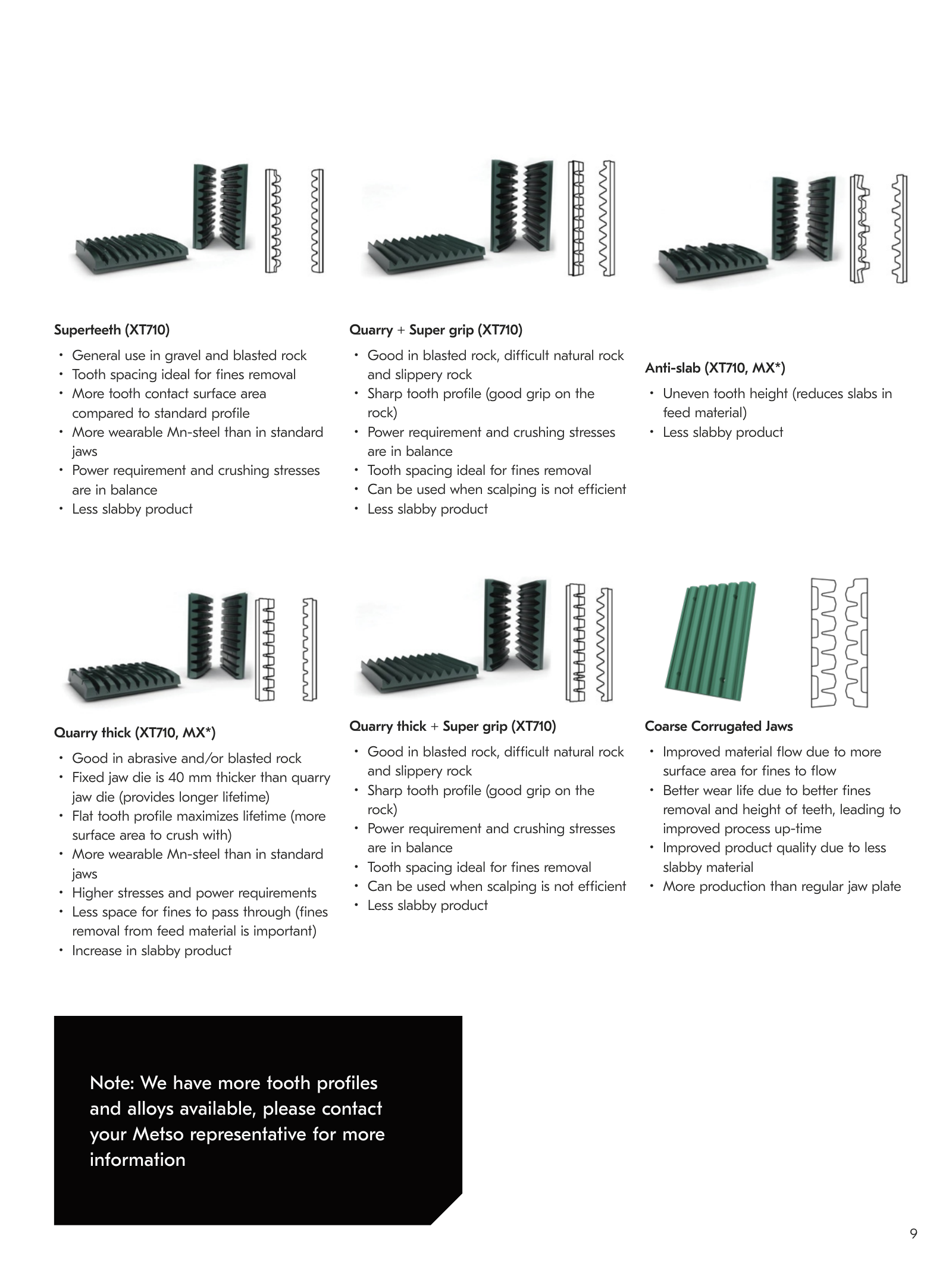
| Brand and model | Specification | Published value |
|---|---|---|
| Metso Superteeth (XT710)Nordberg C Series wear-parts application guide, 07/2023, p.9Manufacturer source | Tooth profile | Superteeth |
| Alloy designation | XT710 | |
| OEM application | Gravel / blasted rock | |
| Profile characteristic | Wider tooth contact area than standard profile | |
| Metso Quarry thick (XT710 / MX)Nordberg C Series wear-parts application guide, 07/2023, p.9Manufacturer source | Fixed-jaw thickness increase over Quarry | +40 mm |
| Alloy/technology designation | XT710 / MX | |
| OEM application | Abrasive / blasted rock | |
| Tooth geometry | Flat tooth profile |
Metso Superteeth (XT710):OEM profile and alloy designation; ordering details use crusher serial, fixed/moving position and part number. Wear-profile research for gravel and blasted rock, explaining how teeth affect grip and fines passage.
Metso Quarry thick (XT710 / MX):The 40 mm is the fixed-jaw increase over the Quarry profile; individual casting dimensions follow the drawing. Wear-profile research for abrasive and blasted rock, explaining the trade-off between added wear material, feed space, fines passage and power.
Sources checked: 2026-09-21 · Published models illustrate specification and content work. Client projects use the models and documents in the client’s actual range.
Application, configuration and quotation content
- Article, position, drawing and casting mass
- Material, profile and production/inspection requirements
- Life, change-out and downtime under stated operating conditions
- Quantity, packing, freight and lead time
We turn these questions into model-page content, technical documents and enquiry fields so sales receives the equipment, operating and delivery requirements together.
Keywords, intent and destination pages
Equipment businesses finding our services
website design for jaw crusher wear parts suppliers; SEO for crusher spare parts exporters; GEO services for mining wear parts companies; jaw plate manufacturer website optimization
These searches lead to this industry page and our website, SEO and GEO service pages. Business owners can review the work and submit their own website and product range.
Equipment purchasing queries for client websites
| Stage / query | Buyer intent | Content and target page | Enquiry action |
|---|---|---|---|
| Identify host and position C106 fixed jaw plate replacement | Identify crusher, fixed-jaw position and drawing version | Host-linked fixed/moving jaw catalog | Send crusher plate, part number and drawing |
| Select tooth profile Superteeth XT710 jaw profile application | Compare grip, fines and feed conditions | Profile/material application guide | Send rock type, feed and wear photos |
| Investigate wear jaw crusher jaw plate wear uneven fines CSS | Relate wear to feeding, scalping and CSS | Wear explanation and operating-condition form | Provide hours, feed and inspection records |
| Compare purchase cost jaw crusher liner cost per tonne quotation | Compare material, life assumptions, downtime and freight | Quotation and cost-per-tonne explanation | Request an article/condition-specific proposal |
AI purchasing prompts and content preparation
These purchasing questions can be tested in ChatGPT, Gemini and AI search experiences. Record the platform, date, region, full response, suppliers mentioned and cited URLs, then compare the findings with the client’s published content.
I need replacement jaw dies for a Metso C106. What crusher serial number, fixed or moving position, tooth profile, drawing and material information should I provide to a wear-parts supplier?
- What to observe
- Check for serial, position and drawing requests, and distinguish profile names from orderable part numbers
- Supporting page content
- Fixed/moving identification diagram, carrier record, part-number and drawing submission guide
Compare Superteeth XT710 and Quarry thick jaw profiles using Metso's application guidance. How do feed material, fines and tooth geometry affect the selection questions a buyer should ask?
- What to observe
- Check profile applications, explain the relative 40 mm increase and discuss fines/power trade-offs
- Supporting page content
- OEM application source, profile explanation and feed/CSS records
How can a quarry compare the cost per tonne of two jaw-liner quotations without assuming the same wear life for different rock, feed grading, CSS and operating practices?
- What to observe
- Check that life comparisons state feed/operating conditions and include change-out and freight cost
- Supporting page content
- Operating record, purchase/change-out cost fields and comparable life data
Optimization work and execution sequence
| Stage | Actions | Deliverable |
|---|---|---|
| Week 1: establish drawings and supply scope | Verify manufactured part numbers, fixed/moving position, material and drawing revision; keep casting and inspection photos linked to the actual item. | Article/host/drawing/material register |
| Week 2: separate identification and material intent | Use model/article queries for replacement intent and profile/wear queries for comparison; document material, feed and CSS context. | Procurement keyword and profile-content map |
| Weeks 3–5: publish parts technical pages | Publish fixed/moving identification, profile applications and wear-material information linked to real drawings/inspection records; collect feed, crusher and wear photos. | Article pages, material guides and condition-based inquiry form |
| Monthly: publish production evidence | Produce four posts on profiles, wear, material inspection and packing, distribute them eight times across Facebook/LinkedIn, and record 60 backlink publications supporting those articles and factory information. | Production/wear posts, publication log and link register |
| Month-end/quarterly: assess useful parts demand | Separate article searches, technical research and quote-ready inquiries monthly; quarterly, expand host coverage based on demand with drawings, rock type and quantity. | Monthly report, catalog priorities and quarterly technical updates |
Monthly reporting separates queries and rankings, GSC impressions and clicks, website visits, contact clicks, saved enquiries, social placements and external publishing. Quarterly reviews explain the changes and set page and content priorities.
How clients and buyers find the site and enquire
| Channel | Query or prompt | Landing page | Next action |
|---|---|---|---|
| SEO agency for crusher wear parts manufacturers | Our jaw-wear-parts service page | Parts business sends its supply catalog and website | |
| Google / AI search | C106 jaw plate tooth profile wear comparison | The client's host-linked parts or profile guide | Buyer supplies article, drawing and operating conditions |
| Facebook / LinkedIn | Material-inspection and wear content | The client's technical article and linked parts page | Move from technical content into a quote-ready parts inquiry |
Facebook and LinkedIn content operations
The standard service produces 4 image-and-text posts a month and publishes them 8 times across Facebook and LinkedIn. Topics draw on technical articles, product pages and sales material, with destination URLs and channel tags recorded.